Showing posts with label Technology. Show all posts

Turkey rolls out domestic rival to WhatsApp

ANKARA:  Turkey has launched a domestic messaging app to rival Facebook´s popular WhatsApp Messenger service.
The app, called PttMessenger after Turkey´s Post and Telegraph General Directorate (PTT), was introduced in a limited roll-out to state institutions and some private companies this week.
It is expected to be publicly available in six months.
PttMessenger will provide a "system safer than WhatsApp", government spokesman Bekir Bozdag told a news conference. 
"Since no data is stored with the host, it will be impossible to access these data. A system safer than WhatsApp has been developed."
Critics cast doubt on the suggestion PttMessenger data could not be retrievd, fearing it will give authorities greater ability to monitor dissent, pointing to the widespread crackdown that was launched after a failed military coup in July 2016.
They cite concerns that PttMessenger might eventally become mandatory downloads for devices used by these institutions, and eventually for the personal electronic devices of employees. 
An estimated 40 percent of the Turkish population were active WhatsApp users as of December 2016, according to research firm Statista.
That was more than double the United States, at 18 percent, but behind several other emerging markets, including Saudi Arabia and Malaysia.

Scientists test human anesthetics on plants, put them to sleep

BERN, Switzerland: A team of scientists in Switzerland has revealed that they have been able to discover a strange way through which plants can be made unconscious for a fixed period of time.
According to media reports, this team of scientists from Italy’s University of Florence and Germany’s University of Bonn, wanted to know how plants like Venus flytrap and Shy plant grow, flourish and come to life after they die. This research has affected scientists’ study of humans and the effects certain anesthetics have on them. 
During the experiment, scientists used an anesthesia named lidocaine, the same drug that is used on humans, on various plants like Mimosa leaves and Venus flytrap.
The plants reacted to the drugs in a similar fashion; they became immobile and unresponsive.
'The fact that plant cells responded to these compounds in a similar manner to animals and humans is intriguing,' the scientists wrote in the study.

Ancient whales were predators not gentle giants: scientists

SYDNEY: Ancient whales had extremely sharp predator teeth similar to lions, Australian scientists said Wednesday in a discovery they believe debunks theories the mammals used their teeth to filter feed like today´s gentle giants.
There are two major groups of whales -- toothed creatures such as killer whales, and baleen, which filter plankton and small fish from the ocean for food with special bristle-like structures in their mouths.
Using 3D scanners, Museums Victoria and Monash University palaeontologists made digital teeth models of fossil baleen whales and today´s mammals from specimen collections around the world.
They found that teeth in ancient baleen whales -- the ancestors of the Southern Right and Blue whale -- were different to the present-day and were instead much sharper.
"These results are the first to show that ancient baleen whales had extremely sharp teeth with one function -- cutting the flesh of their prey," Museums Victoria´s senior curator of vertebrate palaeontology Erich Fitzgerald said.
"Contrary to what many people thought, whales never used their teeth as a sieve, and instead evolved their signature filter feeding technique later -- maybe after their teeth had already been lost."
A previous theory about ancient whales suggested they filtered feed using teeth that when closed formed a zigzag-like sieve, in a similar manner to some living Antarctica seals.
The sieve trapped food in the mouth and also allowed water to flow between the teeth. They were eventually replaced by baleen, the theory added.
The discovery, published Wednesday in the journal Biology Letters, meant "whales completely turned their feeding biology upside down" when they evolved to filter feed, Museums Victoria and Monash University research fellow David Hocking said.
The researchers said there was more work to do to understand the origins of baleen whales, which are Earth´s largest animals, but feed on some of the smallest ocean creatures.

Meet the young Saudi programmer of honesty app ‘Sarahah’


RIYADH: Fizzing with boyish exuberance, Saudi programmer Zainalabdin Tawfiq could be mistaken for a college freshman, but the popularity of his "honesty" app has shone a spotlight on the conservative kingdom´s nascent tech scene.
Tawfiq catapulted to fame when he took time out of his day job as a business analyst last year to develop an anonymous messaging tool called Sarahah -- honesty in Arabic -- that subsequently topped the charts for app downloads.
Initially conceived as a tool for soliciting bluntly frank workplace feedback, Sarahah has found its way into the smartphones of millennials worldwide, even as critics have raised alarm about trolling and privacy issues.
"Sarahah is the digital equivalent of an old-school suggestion box," 29-year-old Tawfiq told AFP, adding that it is built on the premise that stripping users of their identity promotes ruthless honesty.

"Feedback is the goal -- anonymous feedback."
The app has a frugal design and a simple prompt that encourages users to "leave a constructive message :)", with the recipient not allowed to reply but only share it on social media or block the sender.
Its mass appeal stems from the appetite in the Arab world -- notorious for online censorship -- for unfiltered platforms for expression, though Tawfiq said it has also gained a strong popularity in Western countries.
Such has been its power to knock down social barriers that obstruct free speech that one user described it as an app where you can "hit enter on comments you would have otherwise backspaced".
Sarahah has so far drawn 85 million registered users, and rocketed to the top of the Apple app store in some countries, ahead of heavyweights such as Snapchat and Instagram.
- ´Oil´s decline, entrepreneurship´s rise´ -
That a Saudi app could gain such success spotlights hidden potential for tech innovation and entrepreneurship at a time of economic transformation in an ultra-conservative country.
"The success story of Sarahah really proves that Saudi startups can achieve spectacular gains when properly supported," said Nawaf Alsahhaf, CEO of Badir, a government-backed technology incubator that helped Tawfiq.
"There truly is undeniable potential behind Saudi startups we currently incubate," he told AFP.
Saudi Arabia is promoting private enterprise as part of its ambitious reform program to move the kingdom away from its dependence on oil revenues.
"It is clear oil´s decline and entrepreneurship´s rise are necessarily intertwined," the Beirut-based venture capital firm Leap Ventures wrote on its website last year, noting a new growth in disruptive tech innovations in the region.
A new breed of Saudi startups -- from an on-demand roadside assistance app called Morni to Hunger Station, a food ordering portal -- have recently drawn the attention of venture capitalists.
- Minimising abuse -
Tawfiq said he is in negotiations with venture capitalists from the United States, China and the Arab world, without disclosing details, in response to critics who question whether his app can be effectively monetised.
In some gender-segregated Arab societies, men have used Sarahah for secret love confessions, but it has also been used by service delivery companies to harvest constructive feedback and psychiatrists in far-away Mumbai to engage openly on subjects such as sexual health.
Sarahah has come under fire for being a troll magnet -- but Tawfiq said that problem was common to all major social media platforms.
It has also recently been accused of secretly harvesting the address books of users. Tawfiq rejected that claim and said he plans to remove Sarahah´s address upload feature with the next update.
He currently runs a tight ship with another business partner and three customer support executives, but is considering leaving his day job to focus on Sarahah full time.
"I believe that even one case (of abuse) is actually too many," Tawfiq said. "I won´t tell you how, but my aim is to make the job of misusers as difficult as possible."

Facebook takes the next step to monetize WhatsApp: WSJ


Facebook Inc is gearing up to make money from WhatsApp, the messaging service used by more than a billion people every day, the Wall Street Journal reported on Tuesday.
WhatsApp will be testing new features to make it easier for people to communicate with businesses they want to reach on WhatsApp, the messaging service said on a blog post.
“We’re building and testing new tools via a free WhatsApp Business app for small companies and an enterprise solution for bigger companies operating at a large scale with a global base of customers, like airlines, e-commerce sites, and banks,” according to the blog post.
WhatsApp has already started a pilot program that would feature a green badge next to a business contact, indicating that the business was verified by the messaging service.
"We do intend on charging businesses in the future," Chief Operating Officer Matt Idema told the Journal in an interview.
Reuters had reported in March that a potential revenue source for WhatsApp was to charge businesses that want to contact customers, citing company documents.
Started in 2009, WhatsApp was acquired by Facebook for an eye-popping $22 billion in 2014. While WhatsApp had little revenue at the time of the deal, the purchase price was slightly more than the market value of Sony Corp.
Facebook has not focused on WhatsApp so far. The social network had started showing ads inside its Messenger app in July to further monetize the chat service.
Idema declined to describe the paid features or say when they would make their debut, according to the report. “We don’t have the details of monetization figured out,” he told the Journal.

WannaCry ransomware cyber-attack 'may have N Korea link'


Who was behind th
e huge global cyber-attack? One prominent theory right now is North Korea - but what we know is far from conclusive.
You may not have heard of the Lazarus Group, but you may be aware of its work. The devastating hack on Sony Pictures in 2014, and another on a Bangladeshi bank in 2016, have both been attributed to the highly sophisticated group.
It is widely believed that the Lazarus Group worked out of China, but on behalf of the North Koreans.
Security experts are now cautiously linking the Lazarus Group to this latest attack after a discovery by Google security researcher Neel Mehta. He found similarities between code found within WannaCry - the software used in the hack - and other tools believed to have been created by the Lazarus Group in the past.
It's a mere sliver of evidence, but there are other clues to consider too.

Picking apart the code

Prof Alan Woodward, a security expert, pointed out to me that the text demanding the ransom uses what reads like machine-translated English, with a Chinese segment apparently written by a native speaker.
"As you can see it's pretty thin and all circumstantial," Prof Woodward said.
"However, it's worth further investigation."
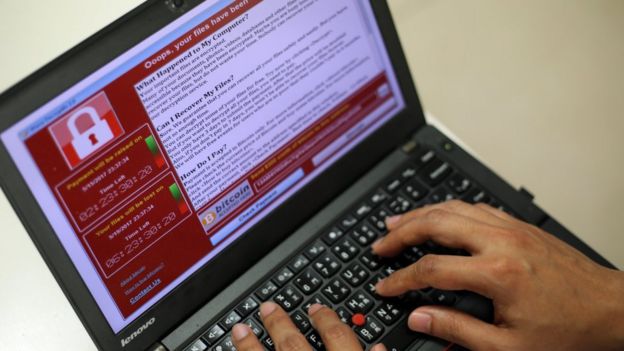
An infected computer
"Neel Mehta’s discovery is the most significant clue to date regarding the origins of WannaCry,” said Russian security firm Kaspersky, but noted a lot more information is needed about earlier versions of WannaCry before any firm conclusion can be reached.
"We believe it’s important that other researchers around the world investigate these similarities and attempt to discover more facts about the origin of WannaCry,” the company added.
"Looking back to the Bangladesh attack, in the early days, there were very few facts linking them to the Lazarus Group.
"In time, more evidence appeared and allowed us, and others, to link them together with high confidence. Further research can be crucial to connecting the dots."

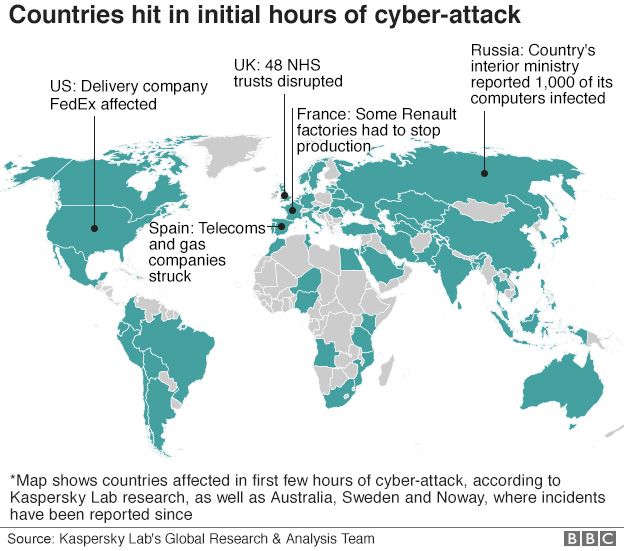
Countries hit in initial hours of cyber-attack
Attributing cyber-attacks can be notoriously difficult - often relying on consensus rather than confirmation.
For example, North Korea has never admitted any involvement in the Sony Pictures hack - and while security researchers, and the US government, have confidence in the theory, neither can rule out the possibility of a false flag.
Skilled hackers may have simply made it look like it had origins in North Korea by using similar techniques.
'Wouldn’t stand up in court'
In the case of WannaCry, it is possible that hackers simply copied code from earlier attacks by the Lazarus Group
But Kaspersky said false flags within WannaCry were "possible" but "improbable", as the shared code was removed from later versions.
"There's a lot of ifs in there," added Prof Woodward.
"It wouldn't stand up in court as it is. But it's worth looking deeper, being conscious of confirmation bias now that North Korea has been identified as a possibility."
It’s the strongest theory yet as to the origin of WannaCry, but there are also details that arguably point away from it being the work of North Korea.
Poster for The Interview
First, China was among the countries worst hit, and not accidentally - the hackers made sure there was a version of the ransom note written in Chinese. It seems unlikely North Korea would want to antagonise its strongest ally. Russia too was badly affected.
Second, North Korean cyber-attacks have typically been far more targeted, often with a political goal in mind.
In the case of Sony Pictures, hackers sought to prevent the release of The Interview, a film that mocked North Korean leader Kim Jong-un. WannaCry, in contrast, was wildly indiscriminate - it would infect anything and everything it could.
Finally, if the plan was simply to make money, it’s been pretty unsuccessful on that front too - only around $60,000 (£46,500) has been paid in ransoms, according to analysis of Bitcoin accounts being used by the criminals.
With more than 200,000 machines infected, it's a terrible return. But then of course, maybe the ransom was a distraction for some other political goal not yet clear.
Another possibility is that the Lazarus Group worked alone, without instruction from North Korea. Indeed, it could be that the Lazarus Group isn’t even linked to North Korea.
More questions than answers - and in cyber-war, facts are extremely hard to come by.

Kategori

Kategori